From Paper Trails to Profit: Why It’s Time to Kill Manual Data Entry
Say goodbye to manual data entry and hello to smarter expense management.
If you’ve ever found yourself hunched over a desk at 5:00 PM on a Friday, squinting at a faded thermal receipt and typing numbers into a spreadsheet, you know that "manual" is just another word for "miserable." It’s a relic of a bygone era, yet many businesses still cling to it like a security blanket that’s actually a fire hazard.
The transition to automated expense management isn’t just about buying new software; it’s about reclaiming your time and protecting your bottom line. Here is why making the switch is the smartest move you’ll make this quarter.
The Hidden Cost of the "Human Touch"
We often think manual entry is "free" because we’re already paying for the employee's time. In reality, it’s one of the most expensive ways to run a back office.
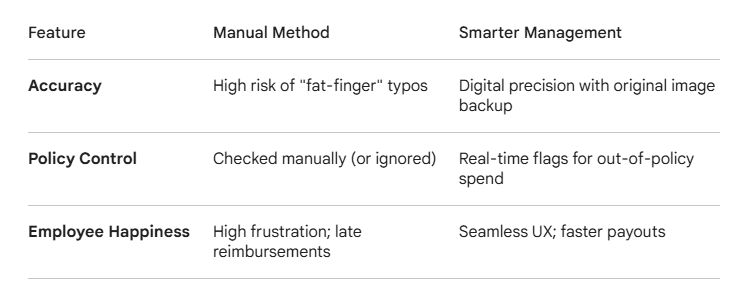
- The Error Tax: Humans are remarkably consistent at being inconsistent. A misplaced decimal point or a forgotten zero can lead to massive reconciliation headaches—or worse, compliance issues during an audit.
- The Productivity Drain: Every hour spent logging a lunch meeting is an hour not spent on strategy, sales, or innovation.
- The Delayed Visibility: Manual systems are reactive. By the time the data is entered, it’s already weeks old. You can't make agile decisions based on "historical" data that should have been "real-time."
What "Smarter" Actually Looks Like
Modern expense management shifts the burden from the person to the platform. By leveraging Optical Character Recognition (OCR) and direct bank integrations, the workflow changes completely:
Snap: An employee takes a photo of a receipt via a mobile app.
Extract: The AI automatically pulls the vendor, date, tax, and total amount.
Sync: The data flows directly into your accounting software, categorized and ready for approval.
The Result: A process that used to take twenty minutes now takes twenty seconds.
Three Gains You Can’t Ignore
The Bottom Line
Moving to a smarter system isn't just a tech upgrade—it’s a culture shift. It tells your team that you value their brainpower more than their data-entry skills. It gives leadership a clear, live view of the company’s financial health. And most importantly, it ensures that your records are audit-ready without the last-minute scramble.
The era of the spreadsheet is ending. It’s time to stop looking at your receipts and start looking at your future.